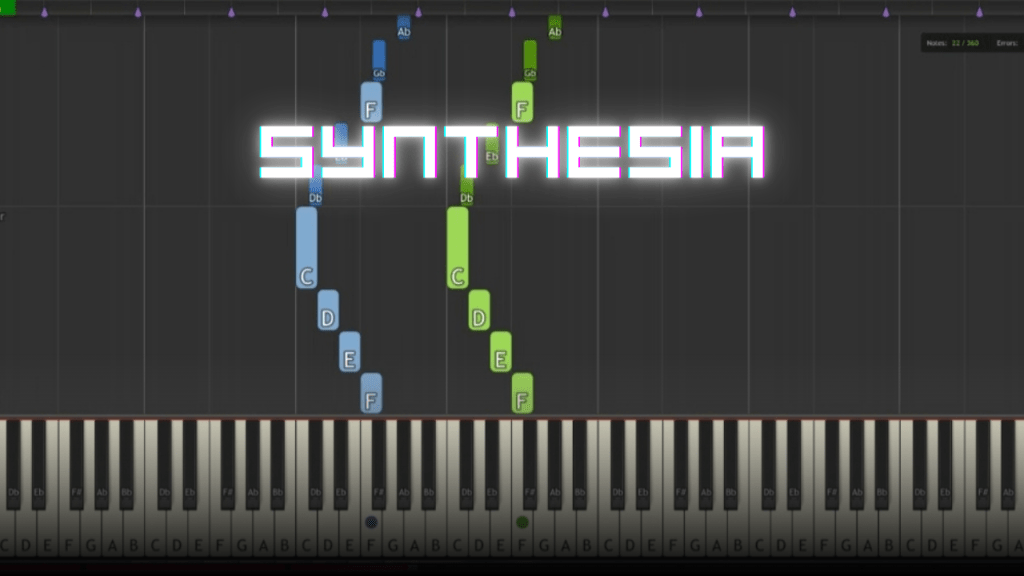
Is Synthesia an Effective Tool for Learning to Play the Piano?

If you want to develop into a well-rounded pianist, it is best used as a supplement alongside learning to read music and potentially taking lessons.

Synthesia is a fun and accessible way to learn to play piano, but is it ideal? Let’s explore the pros and the cons of learning using Synthesia.

PROS: There are some advantages of learning to play piano using Synthesia. It is beginner friendly as it makes learning engaging without the need of reading music. That way, it provides instant gratification. The app has many cool features such as slowing down the tempo, looping sections and practicing hands separately.

CONS: This method solely relies on playing through rote. You use your muscle memory to learn a particular piece without understanding other important aspects of it. It trains your eyes to follow falling blocks instead of reading the staff. It doesnโ€™t teach a student proper techniques, such as good hand shape, fingerings, or body movements. This can develop bad technique habits or even piano related injuries. Furthermore, musicality is completely ignored. The app doesnโ€™t provide any information on expression, dynamics, or phrasing which typically leads to a dry, robotic sound. Synthesia is inefficient for learning harder pieces. You may be able to learn simpler pieces quickly, but learning subsequent, more challenging pieces will be significantly slower.

In conclusion, a holistic approach is essential for effective piano learning. Key elements such as technique, repertoire, music theory, sight reading, and ear training are fundamental aspects of music education and should be integrated into every piano lesson. Additionally, if you want to develop into a well-rounded pianist, it is best used as a supplement alongside learning to read music and potentially taking lessons. If your goal is only to play a few specific songs for fun, it may work.

Practice Smarter, Not Harder: Techniques to Accelerate Your Progress

Effective practice is a key to faster progress. it is important to focus on how to practice, not just what to practice. The following core principles are useful:

  1. Frequent short practice is much more efficient than longer inconsistent sessions. I.e. 15-20 mins daily is better than one or two long sessions per week.
  2. Breaking the piece down into smaller sections, doing hands separate work prevents frustration and makes the learning process more achievable.
  3. Minimize distractions by having a focused time for practice. Keep devices away or in another room.
  4. Practice a passage very slowly to ensure accuracy, and then speed it up to a faster tempo to build dexterity. Alternate between these two speeds to reinforce both precision and fluidity.
  5. Focus on the hardest part first. Identify the most challenging section in the piece and dedicate a significant portion of your practice time there.
  6. Practicing on a slow and steady beat helps build accuracy for notes, rhythms, articulations, dynamics, etc. Slow deliberate practice allows the brain to process each movement and sound correctly. When a mistake occurs, it’s a signal to slow down even more.
  7. Purposeful practice is very important. Instead of mindlessly playing a piece from beginning to end, students should focus on specific sections, techniques, or musical elements.

To sum up, good practice habits help accelerate your progress and achieve your goal quicker.

Tuning Your Ear for Piano Mastery: Developing Aural skills at the Piano ๐ŸŽน

The musicianship components- both sight reading and ear training are very important for the overall development of a music student. Playing by ear can be very rewarding for students who like to play their favorite tunes.

Ear training should be included in the lessons from the very beginning. Few exercises that students can start with are, to be able to identify the direction of notes (going up or down), clapback of short melodies that are played by the teacher, recognise low, middle and high pitch notes aurally and so on.

Once these basics are thorough, theoretical concepts of intervals, chords which building blocks of melodies should be learnt. Interval/chord identification aurally, can then be practiced. Fewer intervals should be introduced at first. Associate the sound of each chord with the mood. For e.g., for major chords, think of them as happy, or bright sounding chords and minor chords as sad, dark, and tense.

Playing short melodies in known keys, can also help in understanding the melodic structure of tunes. Pick your favorite tune and try to play just the melody on the piano. Then, consider adding some bass notes or chords for a fuller sound to the song.

The Royal Conservatory of Music (RCM) has an online tool that allows the students to practice ear tests at all levels. This tool has numerous exercises that prepare students for exams and optimize their progress.

In conclusion, cultivating strong aural skills is paramount for any aspiring pianist. The ability to truly hear and understand music unlocks a deeper level of musicianship, enhancing everything from sight-reading and memorization to improvisation and overall musical expression. By consistent practice of aural tests, a student can becomeย  more confident and expressive in his playing

Is it possible to learn the piano without practicing between lessons?

Piano lessons are a valuable addition to a child’s education in many ways. But just taking lessons and not practicing at home enough can lead to loss of interest and motivation in students. It is a very passive way to learn, and will not lead to any real proficiency.

In order to see progress in any art, consistent practice is an indispensable part of learning. Consistent practice in between lessons has a lot of benefits:

  • Helps solidify techniques learnt in the lesson
  • Repetition is the key to developing muscle memory, and coordination in order to play smoothly and accurately.
  • Retention of learnt concepts, techniques, is better if deliberate practice is done.
  • It helps identify challenges for targeted guidance during the next lesson.
  • Practice isn’t just about hitting the right notes. It’s also about developing your musicality, including rhythm, dynamics, expression, etc.
  • Piano lessons are an investment. By not practicing, you are not getting the value for your money spent.
  • If practice is not done, progress won’t happen, ultimately leading to demotivation.

Lastly, Piano playing is an art that can be very rewarding if your child is ready to persevere through the process and enjoy it.

Understanding Piano Etudes

Each etude focuses on a specific technical and/or musical challenge.

‘Etude’ is a French word that means ‘a study’. Etudes are technical exercises presented as musical pieces. They are incredibly important for piano students of all levels.

Etudes often feature demanding passages that push pianists to their limits, gradually increasing strength, stamina, and overall technical proficiency.ย  Each etude focuses on a specific technical challenge (e.g. finger independence, speed, dynamic control etc.)

Etude is designed to develop proficiency in specific musical challenges as well. Some examples include sudden dynamics contrasts, melodic projection in varying textures, swing rhythm over walking bass accompaniment, articulations and so on.

To sum up, piano etudes are far more than just dry technical exercises. By approaching etudes with focus, intelligence, and a musical ear, pianists can unlock their full potential and deepen their connection with the instrument.

The Effectiveness of Piano Lessons vs. Independent Study

1โ€“2 minutes

In this article, I would like to highlight the benefits of taking piano lessons, and mention the risks associated with self learning.

In today’s world of social media, self learning piano is mostly associated with the use of some kind of online platform such as YouTube videos, self-taught courses, etc. Though they might sound like a more fun and self-paced way to approach piano, there are potential risks linked to this kind of learning.

Self learning the piano can lead to limited progress due to lack of structure, development of poor practice habits such as incorrect posture, hand shape and fingering, and loss of motivation because of no accountability. Piano teaching apps can teach you to play notes, but they may not adequately convey the subtleties and nuances of musical interpretation and expression. Playing the piano is more than just hitting the right keys; it’s about conveying emotion and artistry through your performance.

On the contrary, regular piano lessons offer numerous benefits. A qualified piano teacher can help provide a structured learning path ensuring to build a strong foundation, can identify and correct any technical issues (posture, fingering etc.), provide a personalized feedback tailored to your individual needs and learning style, and encourage consistent practice and motivation.

While self-study can make you feel at ease, the guidance and feedback provided by experienced piano teachers are often crucial for developing proper technique, overcoming plateaus, and achieving consistent progress.

Happy Learning!

Unlocking the Secrets of  Piano Pedals

Piano Pedal Names
1โ€“2 minutes

Piano Pedal technique is fundamental for students right from the elementary stage of learning. A comprehensive grasp of pedal technique is indispensable for pianists. Students develop pedal skills progressively, from beginner to advanced levels. Pedal adds depth, color and expressiveness to your music.

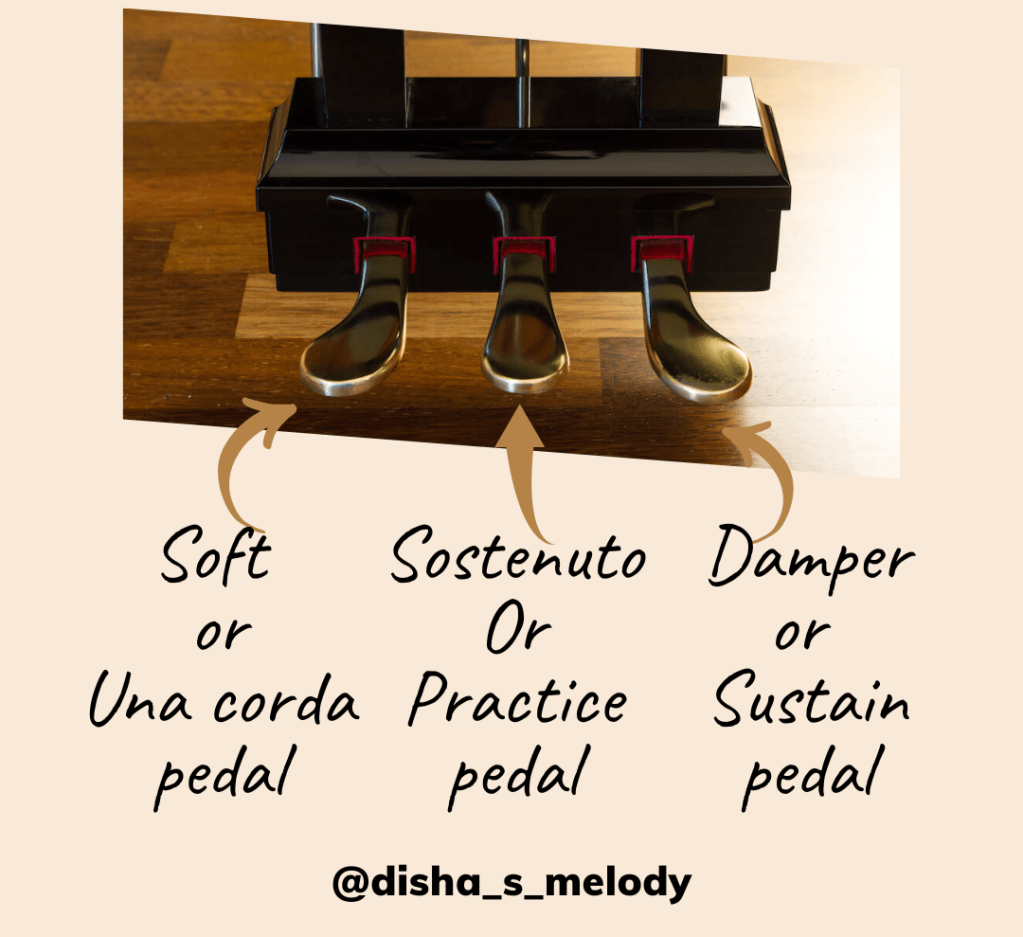
We will examine piano pedals in detail in this article. Let’s learn about the names of three pedals and their functions:

  1. Soft pedal– Soft pedal, also called una corda, is the leftmost one.

    โ€ข Effect- It reduces the volume and creates a softer, more delicate tone.
  2. Sostenuto pedal– This pedal is the middle one. It has different functions depending on the pianos. In the Upright piano, this pedal is also called a practice pedal, which muffles the sound of the piano for quiet practice, whereas in Grand pianos, it allows to sustain selected notes while others decay naturally.
  3. Damper pedal– The rightmost pedal is the most frequently used. It is also called the Sustain Pedal. When pressed, it lifts all the dampers from the strings.

    โ€ข Effect- It creates a richer and resonant tone, connecting the notes close together with a more legato sound.

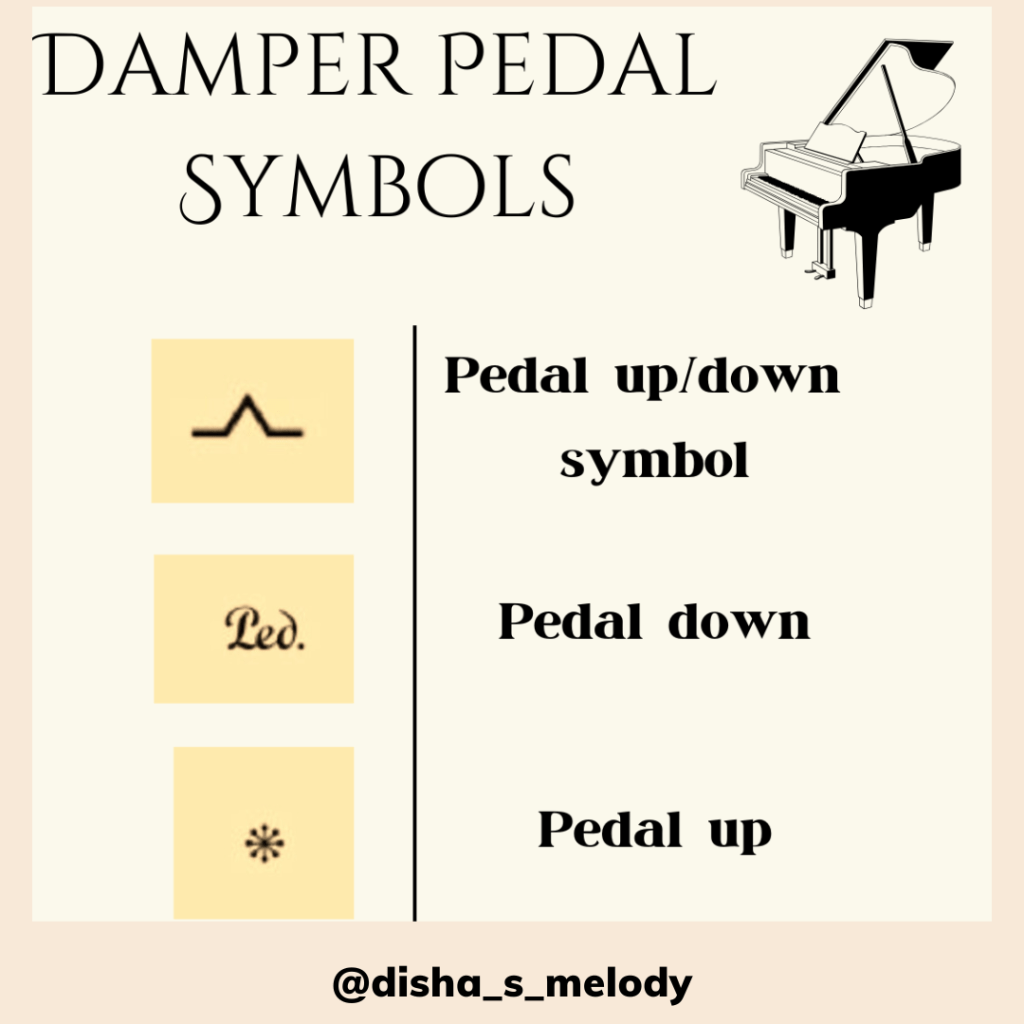
Below, the damper pedal Symbols are shown.

Reading the Damper Pedal Symbols on the Music sheet

Happy Pedaling!

Beyond the Keys: The Importance of Music theory

1โ€“2 minutes

Music theory is crucial for musicians of all levels. A strong knowledge in music theory helps a musician to understand the instrument better. It is indispensible that every music student should be taught theory from the very early stage of his musical career. Just as grammar provides the foundation for effective communication in language, music theory provides the foundation for effective communication in music. Here are some of the benefits of learning music theory:

  1. Foundation for further study: Theory comprises learning about building blocks of music such as scales, chords, key signatures, terms and signs of music, varied rhythms, form and so on. Additional reading: Click on the link below to learn more about rhythm.
  2. Improved sight reading: Reading music at sight can be a challenging skill for many. A good understanding of intervals, chords and their inversions, key signatures etc., can help a student read more efficiently and fast track their progress. Additional reading: Click on the link below to learn more about sight reading.
  3. Enhanced understanding: Music theory explains the rules and patterns that govern melody, harmony, rhythm, and form. This knowledge deepens your appreciation for the music you play and listen to.
  4. Stronger Performance: Theory knowledge enhances the student’s performance skills.  A deeper understanding of phrasing, dynamics, and interpretation will develop, leading to more expressive and nuanced playing.
  5. Increased creativity: Theory provides the tools and knowledge to compose your own music. You learn how to structure a piece, develop a melody, and create a compelling harmonic progression.

Beyond technical proficiency, studying music theory fosters critical thinking, problem-solving, and analytical skills that extend far beyond the musical realm. It cultivates discipline, perseverance, and a deep appreciation for the complexities and nuances of art. In essence, music theory is an enriching journey of intellectual and artistic growth that benefits musicians and music lovers alike.

What new year resolutions should musicians/music students make?

2โ€“3 minutes

New year resolutions are a great way to cultivate new habits in  students’ practice routine. A few important things to consider in order to succeed in the endeavor of changing habits are:

  1. Do it consistently- These days we find people following a streak for every new thing they want to bring into their routine. This is exactly what you need to do in order to stay consistent.
  2. Take small steps to achieve bigger goals- Design your new year resolutions with small baby steps leading you into a bigger goal. For e.g., if your practice goal is to include technique in each practice session, use scales to warm up before you dive in the fun stuff i.e..playing the repertoire
  3. Write it down- Most people miss this one and are not successful in achieving their new year goals. Document it and have it in front of you all the time; on your desk, your laptop wallpaper etc. This will help you stay connected and focussed on your goal.
  4. Set SMART goals- S- Specific, M- Measurable, A- Achievable, R- Relevant, T- Timebound
  5. Enjoy the journey- The process of personal growth is ongoing. Celebrate your efforts and embrace the journey of self-improvement.

Dedication fuels progress in piano. Every student must consider writing down the *why* for learning to play the piano. This can help them discover their own new year resolutions.

Here are the examples of what new year resolutions students can take:

  1. Practice consistently
  2. Listen to the interpretations of various pianists for the pieces you are working on
  3. Focus on technique and musicianship (sight reading and ear training) and incorporate it in practice sessions regularly
  4. Discover different genres such as jazz and blues, or pop
  5. Warm up before playing
  6. Track your progress by using a practice journal
  7. Explore new repertoire
  8. Play for others i.e. practice performing and sharing your music
  9. Use a metronome to achieve steady beat
  10. Study music theory appropriate to your level
  11. Record yourself playing regularly and analyze your recordings to identify and address technical and musical issues.

These are just a few ideas that can help students progress well. It is important that you write down your resolutions in as much detail as you can. Remember to keep them “SMART” as mentioned earlier in this article.

Happy Practicing! Happy 2025!

Piano Practice Strategies

https://www.instagram.com/reel/DA00ducxs8O/?igsh=eGJycGJka2Fxbm5h


1. Have a plan for practice before diving into it- Examples of having a plan can be practicing a particular technical exercise, repertoire and being able to achieve specific things such as practice hands separate, work on voicing of a repertoire and so on.
2. Don’t skip the warm-up at the piano- Warmups should be done at least 10 mins before doing actual work on the piano. It can include some arm and finger stretches, scale and arpeggio exercises, Hanon/Czerny exercises, or even simple etudes.
3. Practice slowly, hands separate before playing hands together- When learning new pieces, slow practice has tremendous results. It is important to get all the details such as notes, rhythms, articulations, voicing, into your practice before trying it up to speed. Hand separate can help learn all these details precisely.
4. Slice up your pieces in small sections- It is always helpful to learn pieces in smaller sections (can be divided in bars, or phrases)
5. Use consistent fingering- Always have a pencil and mark all the fingerings that you are using to keep it consistent.
6. Remove distractions- Any sort of distraction from a device such as a notification on phone or laptop, can be harmful. It can lead to lack of focus. Leave your devices on silent or airplane mode or in another room
7. Listen to recordings- Listening to different interpretations from other artists for the pieces you are practicing, can give you ideas on tone, dynamics, and enhance your artistry at the instrument.
8. Journal your practice- Writing notes of all the practice done can be extremely rewarding as it helps you to track your progress, find out whether the plan you had in the beginning of the practice was followed. It can act as a mirror to your practice routine.